Showing posts with label Jaguar. Show all posts

Jaguar F-Type V6, 2014

Posted by Unknown


The new Jaguar F-Type represents a return to the company's heart: a two-seat, convertible sports car focused on performance, agility and driver involvement. The F-Type is a continuation of a sporting bloodline that stretches back more than 75 years and encompasses some of the most beautiful, thrilling and desirable sports cars ever built. Joining the XK convertible and coupe models, the new F-Type provides Jaguar with a broader line of sports and GT models.

The Jaguar F-Type combines low vehicle weight (starting at 3,521 pounds), high power (340hp, 380hp and 495hp versions) and superb aerodynamics to achieve a pure sports car experience, yet with Jaguar elegance and luxury.

A true two-seat sports car, the all-new Jaguar F-Type is equipped with a modern, lightweight soft top that, when lowered, serves as its own tonneau cover. This not only provides a weight savings, but also improves packaging and contributes to the car's low center of gravity for greater agility. The top can be fully raised or lowered in just 12 seconds at speeds of up to 30 mph. Its multi-layer construction includes a Thinsulate® lining for optimal thermal and sound-insulating properties.

EXTERIOR DESIGN
Jaguar cars have always defined sinuous, muscular elegance, and the F-Type continues - and advances - this tradition with new, assertive design language. Two "heartlines" define, in just two bold strokes, both the profile and top-down view of the Jaguar F-Type. The main "heartline" theme begins in the blade dissecting the shark-like gills on either side of the grille. This first heartline runs up and forms the sharp top crease of the fender line, which provides sight lines that aid the driver in cornering maneuvers. It leads the eye along the top of the front fender, which is emphasized by the headlamp design, and then into the door and toward the rear of the car where it gracefully disappears.

The sweeping line is mirrored by the feature line that runs back from the side vent. Along with "lightcatcher" surface detailing above the sill, the line instills a sense of speed to the car. The lightcatcher surface detailing also allows the door surface to wrap around the side of the car, creating a fuselage effect.

The second "heartline" swells out to form the muscular rear haunch before sweeping dramatically around the rear of the car. The clean, sleek lines of the tail are made possible in part by the inclusion of an active rear spoiler that deploys at speed to reduce aerodynamic lift. The spoiler rises when the F-Type reaches 60 mph and then lowers to fit flush when the speed drops below 40 mph. Further discreet aerodynamic aids include a front splitter and a sculpted rear valance.

The headlights run vertically rather than horizontally, which leads the eye naturally up and along the fender crease. Technology has facilitated the design language of the Jaguar F-Type; the compact xenon unit requires just one projector, while the J-Blade LED running lights further emphasize the design of the heartline running through the lamp.

The grille leans slightly forward to create a suggestion of motion when the car is stationary. The lower edge of the clamshell hood forms the top of the side vent. The mesh in the grille and side vents is a hexagonal design that gives greater form and depth.

The hidden, automatically deploying door handles support the design purity. The handles remain flush with the door panel until activated by either unlocking the car with the key fob or touching a touch-sensitive area of the handle. Their automatic deployment provides a mechanical "handshake," inviting the driver and passenger to enter. Once the car is moving, the handles retract to leave an uninterrupted aerodynamic surface.

Full LED rear lamps create a new Jaguar sports car signature by reinterpreting classic cues from the past. By wrapping the lights around to the trailing edge of the rear wheel arch, the car's powerful rear-wheel drive stance is emphasized. Reflecting the way the front grille leans forward, the tail tucks inward, reinforcing the impression that the car is poised to leap forward.

Differing exhaust and tailpipe designs distinguish the V6 and V8 variants of the F-Type. The V6 models feature twin center outlets in a nod to the classic Jaguar E-Type introduced in 1961. The boldest exhaust finishers ever fitted to a Jaguar, these are stamped from a single piece of stainless steel, creating an unbroken gleaming surface. The V8 S model exclusively features four outboard-mounted exhaust outlets, with twin outlets on each side.

Further detail differentiation between the three variants is found in the exterior trim. The Jaguar F-Type V6 model is marked by satin black trim elements in the grilles, vents, front splitter and rear valance, while the two 'S' models receive gloss-black finishes in these areas. The V6 model features standard 18-inch alloy wheels, with 19-inch and 20-inch wheels standard for the S and V8 S, respectively, and available as options for the V6. The V8 S also receives additional aerodynamic features, including front vanes beneath the shark gills and flat side sill extensions to manage airflow.

ALUMINUM STRUCTURE
Jaguar, which has innovated the use of aluminum body structures, built the new Jaguar F-Type around its most advanced rigid and lightweight aluminum architecture to date. Jaguar engineers applied more than a decade's worth of aluminum construction experience to achieve the twin goals for the F-Type of low mass and an extremely rigid body.

Key to this was the further development of alloy technology. AC300, a 6000-series aluminum alloy, was specifically selected for parts of the Jaguar F-Type to meet these goals. The F-Type structure is riveted and bonded, and this manufacturing process emits up to 80-percent less CO2 compared to that from welding a comparable steel structure.

In addition to the structural alloy, Jaguar further developed an AC600 aluminum panel alloy in order to deliver the desired design language. This AC600 alloy offers robustness and quality of finish but with a great degree of formability. The effects can be seen in the clarity and tightness of radii and feature lines. It was the radius tightness of just 8mm that allowed the engineers to reproduce the car's "heartlines" exactly as the designers had intended.

Aluminum construction, including all-aluminum double wishbone front and rear suspensions, helps endow the F-Type with an ideal balance, which enhances the agility demanded of a pure sports car. The new structural alloys used in the F-Type construction results in high rigidity. Using detailed Computer Aided Engineering programs, Jaguar achieved lateral stiffness gains of up to 30 percent in key areas, such as the front suspension mounting points, compared to other Jaguar models. This rigidity provides a precision foundation for a finely tuned suspension system to deliver a superb driver connectivity and fidelity of response.

Significantly, the beautiful clamshell hood, an exotic signature feature of the Jaguar F-Type and where the front heartline begins, is a one-piece stamping, made using a 1,000-ton press. Jaguar developed other new manufacturing techniques in order to deliver both the design and structural integrity engineered into the F-Type. A new process, known as "warm forming", is used to produce the inner door stamping. The ordinary stamping process with cold metal could not achieve the desired shape. Jaguar engineers developed a method in which the metal is heated to 500°F (260°C) before pressing. As a result, the desired shape and structure are achieved from one large pressing rather than numerous smaller ones, reducing complexity and weight.

The F-Type employs more composite materials than in any previous Jaguar, with structures under the sill and the trunk lid constructed from high-strength polymers. Extensive analysis throughout the car's structure, powertrain, body and convertible roof contributed to the overall vehicle weight of about 3,521 pounds (1,597 kg). Concentrating as much of the mass as possible within the wheelbase by minimizing the front and rear overhangs also contributes to the car's agility and stability.

Aluminum forms a great part of the commitment Jaguar has made to sustainability. More than half the content of the car comes from recycled or reclaimed metal. In addition, Jaguar is rolling out its closed-loop recycling system to its suppliers, ensuring all waste metal from the manufacturing process is reused.

PERFORMANCE
The F-Type showcases the new supercharged Jaguar engines, a 3-liter supercharged V6 in 340hp and 380hp states of tune and the 5-liter supercharged V8 in the Jaguar F-Type V8 S with 495hp and 460 ft-lbs of torque. All are equipped with the new Intelligent Stop/Start system to enhance fuel economy under certain driving conditions.

The 340hp version of the supercharged V6, which debuted in the 2013 XJ and XF sedans, produces 332 ft-lbs of torque at 3,500-5,500 rpm. The 380hp version, exclusive to the F-Type, produces 339 ft-lbs of torque at 3,500-5,500 rpm. The V8 produces an even broader torque curve, with 460 ft-lbs produced over the 2,500-5,500 rpm range.

The 340hp V6 model can accelerate from zero-to-60 mph in 5.1 seconds (0-100km/h in 5.3 seconds). The 380hp S model lowers that to 4.8 seconds (0-100km/h in 4.9 seconds), and the V8 S can hit 60 mph from rest in just 4.2 seconds (0-100km/h in 4.9 seconds). Electronically limited maximum track speeds are 161 mph (260 km/h), 171 mph (275 km/h) and 186 mph (300 km/h), respectively, for the V6, V6 S and V8 S models.

In addition to rapid zero-to-60 acceleration, the new Jaguar supercharged engines give the F-Type outstanding merging and passing performance. The 340hp V6 model will go from 50 to 75 mph in just 3.3 seconds; the 380hp S version in 3.1 and the V8 S model in 2.5 seconds.

Based on the Jaguar 5-liter V8 engine, the 3-liter V6 shares its all-alloy construction. The lightweight die-cast aluminum block is stiffened with cross-bolted main bearing caps, increasing rigidity and refinement. A system of counter-rotating front and rear balancer weights help give the new supercharged V6 the smoothness and refinement characteristics of the V8 on which it is based.

The supercharged V6 and V8 engines combine high compression, direct fuel injection, dual independent variable cam timing (DIVCT) and a supercharger to deliver their high levels of performance and efficiency. A twin vortex supercharger is mounted in the engine's "V", and a water-cooled intercooler reduces the temperature of the intake air to optimize power and efficiency. The supercharged V6 uses a higher compression ratio than the V8, 10.5:1 vs. 9.5:1.

In both the V6 and V8, the aluminum cylinder heads package an innovative valve control system. The dual independent variable cam timing (DIVCT) system is activated by the positive and negative torques generated by the movement of the intake and exhaust valves, allowing exceptionally quick actuation rates of more than 150 degrees per second throughout the rev range.

Spray-guided direct injection delivers precisely measured quantities of fuel directly into the center of the combustion chambers at pressures of up to 150bar (2175 psi) , creating a more homogenous air-fuel mixture for cleaner and more efficient combustion. This is aided by spark plugs that are precisely indexed both in relation to the injector and within the combustion chamber.

Intelligent Stop/Start
The new Intelligent Stop/Start system offers fuel economy benefits under certain urban driving conditions. Stop/Start uses a twin solenoid starter, enabling the system to restart the engine quickly as the driver's foot to move from the brake pedal to the accelerator. There is also a strategy for engine stop-start "change of mind" scenarios. This will bring the engine back up to speed even during its run-down phase if, for instance, the car is coming to a halt at an intersection when the driver sees an opportunity to join the traffic flow. As the engine is shutting down, but before it has completely stopped, it can rapidly restart by injecting fuel into the cylinders.

Active Exhaust
Standard for the V6 S and V8 S models and optional for the V6, an Active Exhaust system enhances the exhaust note. Electronically controlled bypass valves in the rear section of the exhaust open under hard acceleration, effectively providing a free-flowing straight-through arrangement. At cruising speeds, the valves will close, retaining a powerful exhaust note with comfortable sound levels.

Eight-speed 'Quickshift' Automatic Transmission
With eight closely spaced ratios in the Quickshift automatic transmission, the Jaguar F-Type driver can select a gear which will keep the engine within its optimal power band. The transmission was specifically tuned by Jaguar for the F-Type to prioritize acceleration. The V6 S model has a slightly lower (higher numerical) final drive ratio, 3.31:1 vs. 3.15:1 than the standard V6 model.

The entire drivetrain of the F-Type - up to and including tire contact patches - is tuned for optimal response to allow for ultra-fast transient torque delivery, which provides the driver with a high degree of responsive feedback. Importantly, once the transmission has shifted into second gear, a locking clutch bypasses the torque convertor, creating a direct mechanical link between the engine and the rear wheels. The Quickshift system enhances the sense of connectivity by ensuring sharp, immediate shifting performance via rapid and precisely timed engine torque intervention.

The operating parameters of the transmission are determined by the adaptive shift strategy that has 25 different programs available to it, depending on driving style and road conditions. The transmission can detect the manner in which the car is being driven by monitoring acceleration and braking, cornering forces, throttle and brake pedal activity, road load, kick-down request and even whether the car is being driven up or down hill. On detecting a more spirited driving style, the transmission will automatically make the shifts more aggressive and move the shift points higher.

In order to maintain the car's balance during a downshift, the transmission will instruct the engine management system to automatically blip the throttle to match engine revs. This function also allows the transmission to perform multiple and very rapid downshifts during hard braking. Corner Recognition senses when the F-Type is negotiating a curve, the transmission holding its ratio to ensure the correct gear for the exit. The transmission will also recognize when the car is performing a series of overtaking maneuvers requiring rapid changes in throttle position. Rather than upshift, the transmission will hold a lower gear to remain ready for the next demand for acceleration.

Manual override of the transmission is available to the driver at any time, using either the steering wheel-mounted paddles or the console-mounted selector. Moving the shift selector to the left gate accesses manual mode, in which the driver pulls the lever rearward for an upshift and pushes forward for a downshift. If Dynamic Mode is also selected on the Jaguar Drive Controller, the transmission will not automatically shift up at the engine's redline and will only downshift to prevent engine stalling, leaving control fully in the hands of the driver.

A Configurable Dynamics option is another first for a Jaguar. This allows the driver to select which elements of the Dynamic Mode are wanted so, for instance, the steering weight and throttle response can be sharpened while allowing the ride on models with Adaptive Dynamics to remain unchanged. Configurable Dynamics also adds functionality to the central touchscreen aimed at track use of the car. The system allows drivers to record lap and split times and will provide information on throttle and brake inputs and even G-forces generated.

Dynamic Launch Mode
The Jaguar F-Type S offers Dynamic Launch Mode for track-driving activities. When the car is stationary, the driver depresses the brake pedal while simultaneously building engine speed with the accelerator until a message reading 'Dynamic Launch Ready' appears in the instrument panel. That signals that the traction control has been set to help facilitate maximum acceleration. Releasing the brake while flooring the accelerator pedal keeps Dynamic Launch Mode engaged for maximum acceleration performance until the driver releases the pedal.

Limited-Slip Differentials
A mechanical limited-slip differential is fitted as standard to the F-Type S, which offers driver the opportunity to explore the car's superb balance and outer limits of its grip within a progressive handling envelope.

The V8 S model is fitted with an active electronic controlled differential to maximize traction and offer even greater control. Inside the differential, an electric motor acts on a multi-plate clutch to transfer torque to the wheel with the most grip. Fully automatic in operation, the system can apply full locking torque almost instantaneously. Working in conjunction with the stability, traction and ABS systems, it allows for very fine control of power delivery and always makes the most use of available grip.

Braking
The three versions of the Jaguar F-Type offer progressively more powerful braking systems, all with the high levels of pedal feedback required for accurate modulation. The Jaguar Performance system fitted to the 340hp F-Type has 13.9-inch (354mm) front and 12.8-inch (325mm) rear brake discs with silver painted calipers. The F-Type S uses the Jaguar High Performance system, gaining larger 15-inch (380mm) brake discs at the front.

The Jaguar F-Type V8 S uses the Super High Performance system with the largest set of brake discs fitted as standard to a Jaguar production car, including the 15-inch (380mm) front and 14.8-inch (376mm) rear. All cars are fitted as standard with ABS, Electronic Brake Force Distribution and Emergency Brake Assist.

Jaguar engineers used Computational Fluid Dynamics to optimize brake-cooling using directed cooling air. Cold air is channeled to the brake discs via the air intakes flanking the grille and by the use of aerodynamically shaped suspension components to direct airflow beneath the car.

HANDLING DYNAMICS
The aluminum structure of the F-Type ensures the best possible connection for the driver to the road. Every response from the steering to the transmission shifting, throttle, brakes and suspension has been finely honed to be as connected, accurate and involving as possible.

"Fundamentally, a great sports car is one you'll look forward to driving because it's fun, and the F-Type definitely delivers on that score. We've worked hard to make sure that responses to steering, throttle and brakes are absolutely immediate, a task made far easier by the rigid aluminum structure at the car's base. It's precise and exciting, a car that you'll want to drive for the sake of driving alone - and it sounds fantastic." Mike Cross, Chief Engineer, Vehicle Integrity, Jaguar

Agility in the Jaguar F-Type begins with its dimensions, which give the car a planted, "wheels pushed to the corners" stance. The F-Type measures 176 inches (4,470mm) in length on a 103.2-in. (2,622 mm) wheelbase. The track is wider in rear than front, 64.1-in. (1,585mm) and 62.4-in. (1,627mm), respectively.

Short front and rear overhangs also help in concentrating the mass within the wheelbase, reducing the moment of inertia and making the car much more immediate to turn in. To fully exploit this trait, Jaguar engineers paid particular attention to optimizing front-to-rear weight distribution. To that end, both the battery and windshield washer fluid reservoir have been placed in the trunk, rather than under the hood.

To give the steering the greatest accuracy in response and feedback, the F-Type uses an alloy front sub frame and very stiff front knuckles, also in aluminum. This arrangement allowed the fitment of the quickest steering rack ever used on a modern Jaguar, giving the driver a very connected-to-the-road feeling.

Every Jaguar is engineered and tuned to achieve an excellent balance between ride comfort and handling. In the Jaguar F-Type, that balance naturally tips in favor of involving, accessible handling while still maintaining excellent ride compliance. The Dynamic Mode enables the driver - at the push of a button - to emphasize the sporting character of the car by sharpening throttle response, increasing steering weighting, performing gear changes more quickly and higher up the rev range and by also raising the threshold for stability control intervention. Dynamic mode also prevents automatic upshifts when the gearbox is shifted into manual mode.

Additionally, the F-Type S and V8 S models are fitted with the Jaguar Adaptive Dynamics suspension damping system that controls vertical body movement, roll and pitch rates. The system continuously monitors driver inputs and the attitude of the F-Type on the road, adjusting damper rates accordingly up to 500 times a second to optimize stability and agility. The Dynamic Mode in these models also provides firmer damper rates through the Adaptive Dynamics system.

DRIVER ENVIRONMENT
The F-Type asymmetric cabin layout reflects the sharp focus on the driver. The aim was to create an enveloping cockpit for the driver with all the controls placed naturally to hand and logically grouped, allowing maximum attention on the driving experience.

A grab handle sweeps down the center console on the passenger side, delineating it from the driver's position and wrapping around the center console. Different finishes in the driver and passenger areas are used, including a different grain on top of the instrument panel and center console than that found on the passenger side. In the S and V8 S models, the main control interfaces - the Engine Start button, steering wheel mounted gearshift paddles and Dynamic Mode toggle - are highlighted in an "Ignis" orange finish, similar to that used on the markings on professional divers' watches. The controls are ergonomically grouped by function, enabling the driver to more easily use them without diverting eyes from the road.

A small-diameter three-spoke steering wheel will also be available in a flat-bottom design, as part of an optional Performance Pack. Numerals on the tachometer are larger and bolder than those on the speedometer, to enhance visibility when for shifting. A TFT LCD screen between the two dials provides further information for the driver.

Rotary dials control the heating and air conditioning for each side of the car. A display screen within the two dials indicates temperature and mode. The controls are dual-purpose: in cars fitted with heated seats, pushing the left or right hand dial controls temperature for that seat. A row of toggle switches below the dials control additional climate functions, their design echoing classic Jaguar sports cars. The air vents on top of the dashboard are hidden, and will deploy by rising out of the dashboard only when instructed to by either the driver or climate control system, staying tucked discreetly out of sight in other circumstances.

Switches are finished in soft-feel matte black with white markings for maximum legibility, and the highlight accents are deliberately understated satin chrome and dark aluminum. The two S models feature darker finishes than in the standard V6 Jaguar F-Type.

Sports seats feature power recline and height adjustment with manual control of fore/aft movement, a nod to weight reduction. Available Performance seats can be ordered with additional side bolstering for greater support during high-force cornering. Both seat types can also be optioned with full power adjustment, including adjustable lumbar and side support. The car's driving position is 20mm lower than in the Jaguar XKR-S, lowering the center of gravity and allowing the driver to feel more connected to the car.

The Jaguar F-Type is available with two audio systems from premium British audio experts Meridian™. These offer either 10 or 12 speakers with outputs of 380 watts and 770 watts, respectively. The Meridian™ systems benefit from the company's experience in digital signal processing to create life-like audio reproduction. The top of the range offering also features the Meridian™ Trifield System, which places both occupants at the center of their own perfectly focused surround sound field.
More about → Jaguar F-Type V6, 2014

Jaguar F-Type, 2014

Posted by Unknown


The new Jaguar F-Type represents a return to the company's heart: a two-seat, convertible sports car focused on performance, agility and driver involvement. The F-Type is a continuation of a sporting bloodline that stretches back more than 75 years and encompasses some of the most beautiful, thrilling and desirable sports cars ever built. Joining the XK convertible and coupe models, the new F-Type provides Jaguar with a broader line of sports and GT models.

The 2014 Jaguar F-Type combines low vehicle weight (starting at 3,521 pounds), high power (340hp, 380hp and 495hp versions) and superb aerodynamics to achieve a pure sports car experience, yet with Jaguar elegance and luxury.

A true two-seat sports car, the all-new Jaguar F-Type is equipped with a modern, lightweight soft top that, when lowered, serves as its own tonneau cover. This not only provides a weight savings, but also improves packaging and contributes to the car's low center of gravity for greater agility. The top can be fully raised or lowered in just 12 seconds at speeds of up to 30 mph. Its multi-layer construction includes a Thinsulate® lining for optimal thermal and sound-insulating properties.

EXTERIOR DESIGN
Jaguar cars have always defined sinuous, muscular elegance, and the F-Type continues - and advances - this tradition with new, assertive design language. Two "heartlines" define, in just two bold strokes, both the profile and top-down view of the Jaguar F-Type. The main "heartline" theme begins in the blade dissecting the shark-like gills on either side of the grille. This first heartline runs up and forms the sharp top crease of the fender line, which provides sight lines that aid the driver in cornering maneuvers. It leads the eye along the top of the front fender, which is emphasized by the headlamp design, and then into the door and toward the rear of the car where it gracefully disappears.

The sweeping line is mirrored by the feature line that runs back from the side vent. Along with "lightcatcher" surface detailing above the sill, the line instills a sense of speed to the car. The lightcatcher surface detailing also allows the door surface to wrap around the side of the car, creating a fuselage effect.

The second "heartline" swells out to form the muscular rear haunch before sweeping dramatically around the rear of the car. The clean, sleek lines of the tail are made possible in part by the inclusion of an active rear spoiler that deploys at speed to reduce aerodynamic lift. The spoiler rises when the F-Type reaches 60 mph and then lowers to fit flush when the speed drops below 40 mph. Further discreet aerodynamic aids include a front splitter and a sculpted rear valance.

The headlights run vertically rather than horizontally, which leads the eye naturally up and along the fender crease. Technology has facilitated the design language of the Jaguar F-Type; the compact xenon unit requires just one projector, while the J-Blade LED running lights further emphasize the design of the heartline running through the lamp.

The grille leans slightly forward to create a suggestion of motion when the car is stationary. The lower edge of the clamshell hood forms the top of the side vent. The mesh in the grille and side vents is a hexagonal design that gives greater form and depth.

The hidden, automatically deploying door handles support the design purity. The handles remain flush with the door panel until activated by either unlocking the car with the key fob or touching a touch-sensitive area of the handle. Their automatic deployment provides a mechanical "handshake," inviting the driver and passenger to enter. Once the car is moving, the handles retract to leave an uninterrupted aerodynamic surface.

Full LED rear lamps create a new Jaguar sports car signature by reinterpreting classic cues from the past. By wrapping the lights around to the trailing edge of the rear wheel arch, the car's powerful rear-wheel drive stance is emphasized. Reflecting the way the front grille leans forward, the tail tucks inward, reinforcing the impression that the car is poised to leap forward.

Differing exhaust and tailpipe designs distinguish the V6 and V8 variants of the F-Type. The V6 models feature twin center outlets in a nod to the classic Jaguar E-Type introduced in 1961. The boldest exhaust finishers ever fitted to a Jaguar, these are stamped from a single piece of stainless steel, creating an unbroken gleaming surface. The V8 S model exclusively features four outboard-mounted exhaust outlets, with twin outlets on each side.

Further detail differentiation between the three variants is found in the exterior trim. The Jaguar F-Type V6 model is marked by satin black trim elements in the grilles, vents, front splitter and rear valance, while the two 'S' models receive gloss-black finishes in these areas. The V6 model features standard 18-inch alloy wheels, with 19-inch and 20-inch wheels standard for the S and V8 S, respectively, and available as options for the V6. The V8 S also receives additional aerodynamic features, including front vanes beneath the shark gills and flat side sill extensions to manage airflow.

ALUMINUM STRUCTURE
Jaguar, which has innovated the use of aluminum body structures, built the new Jaguar F-Type around its most advanced rigid and lightweight aluminum architecture to date. Jaguar engineers applied more than a decade's worth of aluminum construction experience to achieve the twin goals for the F-Type of low mass and an extremely rigid body.

Key to this was the further development of alloy technology. AC300, a 6000-series aluminum alloy, was specifically selected for parts of the Jaguar F-Type to meet these goals. The F-Type structure is riveted and bonded, and this manufacturing process emits up to 80-percent less CO2 compared to that from welding a comparable steel structure.

In addition to the structural alloy, Jaguar further developed an AC600 aluminum panel alloy in order to deliver the desired design language. This AC600 alloy offers robustness and quality of finish but with a great degree of formability. The effects can be seen in the clarity and tightness of radii and feature lines. It was the radius tightness of just 8mm that allowed the engineers to reproduce the car's "heartlines" exactly as the designers had intended.

Aluminum construction, including all-aluminum double wishbone front and rear suspensions, helps endow the F-Type with an ideal balance, which enhances the agility demanded of a pure sports car. The new structural alloys used in the F-Type construction results in high rigidity. Using detailed Computer Aided Engineering programs, Jaguar achieved lateral stiffness gains of up to 30 percent in key areas, such as the front suspension mounting points, compared to other Jaguar models. This rigidity provides a precision foundation for a finely tuned suspension system to deliver a superb driver connectivity and fidelity of response.

Significantly, the beautiful clamshell hood, an exotic signature feature of the Jaguar F-Type and where the front heartline begins, is a one-piece stamping, made using a 1,000-ton press. Jaguar developed other new manufacturing techniques in order to deliver both the design and structural integrity engineered into the F-Type. A new process, known as "warm forming", is used to produce the inner door stamping. The ordinary stamping process with cold metal could not achieve the desired shape. Jaguar engineers developed a method in which the metal is heated to 500°F (260°C) before pressing. As a result, the desired shape and structure are achieved from one large pressing rather than numerous smaller ones, reducing complexity and weight.

The F-Type employs more composite materials than in any previous Jaguar, with structures under the sill and the trunk lid constructed from high-strength polymers. Extensive analysis throughout the car's structure, powertrain, body and convertible roof contributed to the overall vehicle weight of about 3,521 pounds (1,597 kg). Concentrating as much of the mass as possible within the wheelbase by minimizing the front and rear overhangs also contributes to the car's agility and stability.

Aluminum forms a great part of the commitment Jaguar has made to sustainability. More than half the content of the car comes from recycled or reclaimed metal. In addition, Jaguar is rolling out its closed-loop recycling system to its suppliers, ensuring all waste metal from the manufacturing process is reused.

PERFORMANCE
The F-Type showcases the new supercharged Jaguar engines, a 3-liter supercharged V6 in 340hp and 380hp states of tune and the 5-liter supercharged V8 in the Jaguar F-Type V8 S with 495hp and 460 ft-lbs of torque. All are equipped with the new Intelligent Stop/Start system to enhance fuel economy under certain driving conditions.

The 340hp version of the supercharged V6, which debuted in the 2013 XJ and XF sedans, produces 332 ft-lbs of torque at 3,500-5,500 rpm. The 380hp version, exclusive to the F-Type, produces 339 ft-lbs of torque at 3,500-5,500 rpm. The V8 produces an even broader torque curve, with 460 ft-lbs produced over the 2,500-5,500 rpm range.

The 340hp V6 model can accelerate from zero-to-60 mph in 5.1 seconds (0-100km/h in 5.3 seconds). The 380hp S model lowers that to 4.8 seconds (0-100km/h in 4.9 seconds), and the V8 S can hit 60 mph from rest in just 4.2 seconds (0-100km/h in 4.9 seconds). Electronically limited maximum track speeds are 161 mph (260 km/h), 171 mph (275 km/h) and 186 mph (300 km/h), respectively, for the V6, V6 S and V8 S models.

In addition to rapid zero-to-60 acceleration, the new Jaguar supercharged engines give the F-Type outstanding merging and passing performance. The 340hp V6 model will go from 50 to 75 mph in just 3.3 seconds; the 380hp S version in 3.1 and the V8 S model in 2.5 seconds.

Based on the Jaguar 5-liter V8 engine, the 3-liter V6 shares its all-alloy construction. The lightweight die-cast aluminum block is stiffened with cross-bolted main bearing caps, increasing rigidity and refinement. A system of counter-rotating front and rear balancer weights help give the new supercharged V6 the smoothness and refinement characteristics of the V8 on which it is based.

The supercharged V6 and V8 engines combine high compression, direct fuel injection, dual independent variable cam timing (DIVCT) and a supercharger to deliver their high levels of performance and efficiency. A twin vortex supercharger is mounted in the engine's "V", and a water-cooled intercooler reduces the temperature of the intake air to optimize power and efficiency. The supercharged V6 uses a higher compression ratio than the V8, 10.5:1 vs. 9.5:1.

In both the V6 and V8, the aluminum cylinder heads package an innovative valve control system. The dual independent variable cam timing (DIVCT) system is activated by the positive and negative torques generated by the movement of the intake and exhaust valves, allowing exceptionally quick actuation rates of more than 150 degrees per second throughout the rev range.

Spray-guided direct injection delivers precisely measured quantities of fuel directly into the center of the combustion chambers at pressures of up to 150bar (2175 psi) , creating a more homogenous air-fuel mixture for cleaner and more efficient combustion. This is aided by spark plugs that are precisely indexed both in relation to the injector and within the combustion chamber.

Intelligent Stop/Start
The new Intelligent Stop/Start system offers fuel economy benefits under certain urban driving conditions. Stop/Start uses a twin solenoid starter, enabling the system to restart the engine quickly as the driver's foot to move from the brake pedal to the accelerator. There is also a strategy for engine stop-start "change of mind" scenarios. This will bring the engine back up to speed even during its run-down phase if, for instance, the car is coming to a halt at an intersection when the driver sees an opportunity to join the traffic flow. As the engine is shutting down, but before it has completely stopped, it can rapidly restart by injecting fuel into the cylinders.

Active Exhaust
Standard for the V6 S and V8 S models and optional for the V6, an Active Exhaust system enhances the exhaust note. Electronically controlled bypass valves in the rear section of the exhaust open under hard acceleration, effectively providing a free-flowing straight-through arrangement. At cruising speeds, the valves will close, retaining a powerful exhaust note with comfortable sound levels.

Eight-speed 'Quickshift' Automatic Transmission
With eight closely spaced ratios in the Quickshift automatic transmission, the Jaguar F-Type driver can select a gear which will keep the engine within its optimal power band. The transmission was specifically tuned by Jaguar for the F-Type to prioritize acceleration. The V6 S model has a slightly lower (higher numerical) final drive ratio, 3.31:1 vs. 3.15:1 than the standard V6 model.

The entire drivetrain of the F-Type - up to and including tire contact patches - is tuned for optimal response to allow for ultra-fast transient torque delivery, which provides the driver with a high degree of responsive feedback. Importantly, once the transmission has shifted into second gear, a locking clutch bypasses the torque convertor, creating a direct mechanical link between the engine and the rear wheels. The Quickshift system enhances the sense of connectivity by ensuring sharp, immediate shifting performance via rapid and precisely timed engine torque intervention.

The operating parameters of the transmission are determined by the adaptive shift strategy that has 25 different programs available to it, depending on driving style and road conditions. The transmission can detect the manner in which the car is being driven by monitoring acceleration and braking, cornering forces, throttle and brake pedal activity, road load, kick-down request and even whether the car is being driven up or down hill. On detecting a more spirited driving style, the transmission will automatically make the shifts more aggressive and move the shift points higher.

In order to maintain the car's balance during a downshift, the transmission will instruct the engine management system to automatically blip the throttle to match engine revs. This function also allows the transmission to perform multiple and very rapid downshifts during hard braking. Corner Recognition senses when the F-Type is negotiating a curve, the transmission holding its ratio to ensure the correct gear for the exit. The transmission will also recognize when the car is performing a series of overtaking maneuvers requiring rapid changes in throttle position. Rather than upshift, the transmission will hold a lower gear to remain ready for the next demand for acceleration.

Manual override of the transmission is available to the driver at any time, using either the steering wheel-mounted paddles or the console-mounted selector. Moving the shift selector to the left gate accesses manual mode, in which the driver pulls the lever rearward for an upshift and pushes forward for a downshift. If Dynamic Mode is also selected on the Jaguar Drive Controller, the transmission will not automatically shift up at the engine's redline and will only downshift to prevent engine stalling, leaving control fully in the hands of the driver.

A Configurable Dynamics option is another first for a Jaguar. This allows the driver to select which elements of the Dynamic Mode are wanted so, for instance, the steering weight and throttle response can be sharpened while allowing the ride on models with Adaptive Dynamics to remain unchanged. Configurable Dynamics also adds functionality to the central touchscreen aimed at track use of the car. The system allows drivers to record lap and split times and will provide information on throttle and brake inputs and even G-forces generated.

Dynamic Launch Mode
The Jaguar F-Type S offers Dynamic Launch Mode for track-driving activities. When the car is stationary, the driver depresses the brake pedal while simultaneously building engine speed with the accelerator until a message reading 'Dynamic Launch Ready' appears in the instrument panel. That signals that the traction control has been set to help facilitate maximum acceleration. Releasing the brake while flooring the accelerator pedal keeps Dynamic Launch Mode engaged for maximum acceleration performance until the driver releases the pedal.

Limited-Slip Differentials
A mechanical limited-slip differential is fitted as standard to the F-Type S, which offers driver the opportunity to explore the car's superb balance and outer limits of its grip within a progressive handling envelope.

The V8 S model is fitted with an active electronic controlled differential to maximize traction and offer even greater control. Inside the differential, an electric motor acts on a multi-plate clutch to transfer torque to the wheel with the most grip. Fully automatic in operation, the system can apply full locking torque almost instantaneously. Working in conjunction with the stability, traction and ABS systems, it allows for very fine control of power delivery and always makes the most use of available grip.

Braking
The three versions of the Jaguar F-Type offer progressively more powerful braking systems, all with the high levels of pedal feedback required for accurate modulation. The Jaguar Performance system fitted to the 340hp F-Type has 13.9-inch (354mm) front and 12.8-inch (325mm) rear brake discs with silver painted calipers. The F-Type S uses the Jaguar High Performance system, gaining larger 15-inch (380mm) brake discs at the front.

The Jaguar F-Type V8 S uses the Super High Performance system with the largest set of brake discs fitted as standard to a Jaguar production car, including the 15-inch (380mm) front and 14.8-inch (376mm) rear. All cars are fitted as standard with ABS, Electronic Brake Force Distribution and Emergency Brake Assist.

Jaguar engineers used Computational Fluid Dynamics to optimize brake-cooling using directed cooling air. Cold air is channeled to the brake discs via the air intakes flanking the grille and by the use of aerodynamically shaped suspension components to direct airflow beneath the car.

HANDLING DYNAMICS
The aluminum structure of the F-Type ensures the best possible connection for the driver to the road. Every response from the steering to the transmission shifting, throttle, brakes and suspension has been finely honed to be as connected, accurate and involving as possible.

Agility in the Jaguar F-Type begins with its dimensions, which give the car a planted, "wheels pushed to the corners" stance. The F-Type measures 176 inches (4,470mm) in length on a 103.2-in. (2,622 mm) wheelbase. The track is wider in rear than front, 64.1-in. (1,585mm) and 62.4-in. (1,627mm), respectively.

Short front and rear overhangs also help in concentrating the mass within the wheelbase, reducing the moment of inertia and making the car much more immediate to turn in. To fully exploit this trait, Jaguar engineers paid particular attention to optimizing front-to-rear weight distribution. To that end, both the battery and windshield washer fluid reservoir have been placed in the trunk, rather than under the hood.

To give the steering the greatest accuracy in response and feedback, the F-Type uses an alloy front sub frame and very stiff front knuckles, also in aluminum. This arrangement allowed the fitment of the quickest steering rack ever used on a modern Jaguar, giving the driver a very connected-to-the-road feeling.

Every Jaguar is engineered and tuned to achieve an excellent balance between ride comfort and handling. In the Jaguar F-Type, that balance naturally tips in favor of involving, accessible handling while still maintaining excellent ride compliance. The Dynamic Mode enables the driver - at the push of a button - to emphasize the sporting character of the car by sharpening throttle response, increasing steering weighting, performing gear changes more quickly and higher up the rev range and by also raising the threshold for stability control intervention. Dynamic mode also prevents automatic upshifts when the gearbox is shifted into manual mode.

Additionally, the F-Type S and V8 S models are fitted with the Jaguar Adaptive Dynamics suspension damping system that controls vertical body movement, roll and pitch rates. The system continuously monitors driver inputs and the attitude of the F-Type on the road, adjusting damper rates accordingly up to 500 times a second to optimize stability and agility. The Dynamic Mode in these models also provides firmer damper rates through the Adaptive Dynamics system.

DRIVER ENVIRONMENT
The F-Type asymmetric cabin layout reflects the sharp focus on the driver. The aim was to create an enveloping cockpit for the driver with all the controls placed naturally to hand and logically grouped, allowing maximum attention on the driving experience.

A grab handle sweeps down the center console on the passenger side, delineating it from the driver's position and wrapping around the center console. Different finishes in the driver and passenger areas are used, including a different grain on top of the instrument panel and center console than that found on the passenger side. In the S and V8 S models, the main control interfaces - the Engine Start button, steering wheel mounted gearshift paddles and Dynamic Mode toggle - are highlighted in an "Ignis" orange finish, similar to that used on the markings on professional divers' watches. The controls are ergonomically grouped by function, enabling the driver to more easily use them without diverting eyes from the road.

A small-diameter three-spoke steering wheel will also be available in a flat-bottom design, as part of an optional Performance Pack. Numerals on the tachometer are larger and bolder than those on the speedometer, to enhance visibility when for shifting. A TFT LCD screen between the two dials provides further information for the driver.

Rotary dials control the heating and air conditioning for each side of the car. A display screen within the two dials indicates temperature and mode. The controls are dual-purpose: in cars fitted with heated seats, pushing the left or right hand dial controls temperature for that seat. A row of toggle switches below the dials control additional climate functions, their design echoing classic Jaguar sports cars. The air vents on top of the dashboard are hidden, and will deploy by rising out of the dashboard only when instructed to by either the driver or climate control system, staying tucked discreetly out of sight in other circumstances.

Switches are finished in soft-feel matte black with white markings for maximum legibility, and the highlight accents are deliberately understated satin chrome and dark aluminum. The two S models feature darker finishes than in the standard V6 Jaguar F-Type.

Sports seats feature power recline and height adjustment with manual control of fore/aft movement, a nod to weight reduction. Available Performance seats can be ordered with additional side bolstering for greater support during high-force cornering. Both seat types can also be optioned with full power adjustment, including adjustable lumbar and side support. The car's driving position is 20mm lower than in the Jaguar XKR-S, lowering the center of gravity and allowing the driver to feel more connected to the car.

The Jaguar F-Type is available with two audio systems from premium British audio experts Meridian™. These offer either 10 or 12 speakers with outputs of 380 watts and 770 watts, respectively. The Meridian™ systems benefit from the company's experience in digital signal processing to create life-like audio reproduction. The top of the range offering also features the Meridian™ Trifield System, which places both occupants at the center of their own perfectly focused surround sound field.
More about → Jaguar F-Type, 2014

Jaguar C-X17 Concept, 2013

Posted by Unknown


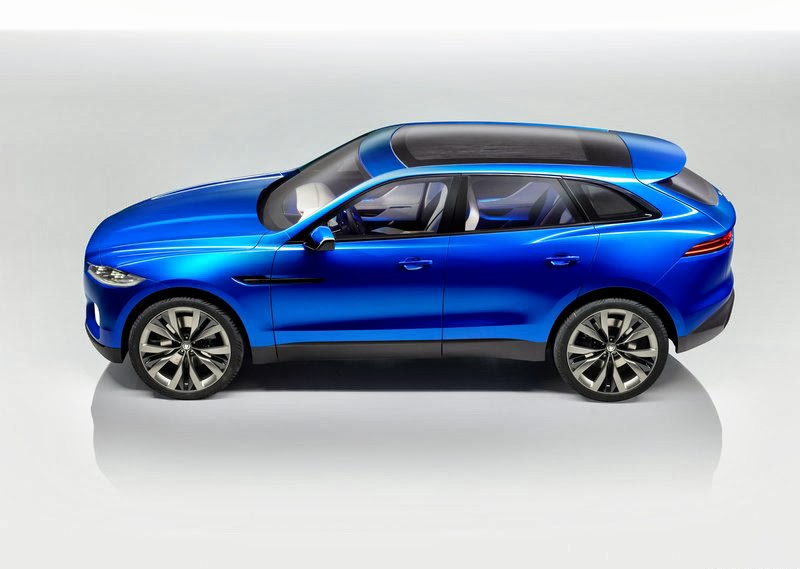
The Jaguar C-X17 concept illustrates the diversity of vehicles that could be produced using the architecture. A four-seater sports crossover concept built on the aluminium-intensive architecture, it blends sleek lines, sporting design and luxurious sophistication with enhanced flexibility and an assured driving position. In its exciting proportions, purity of form and its beautiful lines - overseen by Director of Design Ian Callum - the C-X17 is every inch a Jaguar.
The Jaguar C-X17 has been created as a design study to introduce Jaguar's all-new advanced aluminium monocoque architecture, codenamed iQ[Al], on which an exciting range of future Jaguars will be built. This new philosophy underpins the entire innovative future of the Jaguar brand. A modular and scalable vehicle architecture, engineered and developed for Jaguar, the architecture is high-strength, lightweight, extremely stiff and incorporates innovative efficiency technologies. It enables flexible high-volume production while allowing creative design freedom and competitive interior packaging, without compromising the unique character, dynamics, performance and luxury that Jaguar is famous for. This will enable Jaguar to grow its product portfolio, targeting high-growth areas of the premium market.

Jaguar's first ever sports crossover concept vehicle - the Jaguar C-X17 - made its debut at the 2013 Frankfurt Motor Show.

As a sports crossover, the Jaguar C-X17 stretches the design possibilities of the segment by combining the character and driving experience of a sports car with increased presence, style and flexibility. The sports crossover concept represents the potential expansion of Jaguar's portfolio of body styles, with the associated enhancement of the brand's relevance and appeal to a wider global audience.

Jaguar's first product from the new iQ[Al] architecture will be a new premium C/D segment sedan. Its global rollout will begin in 2015, and it the first aluminium monocoque product in the segment.

Power provided by engines with a wide range of capacities and output, all delivering inspirational performance and offering the latest innovations in fuel-efficient technologies without sacrificing drivability. These will include the high-output petrol and diesel engines to be built at Jaguar Land Rover's new engine manufacturing facility in the UK, as well as the powerful V6 petrol engine in the F-Type, which will provide best-in-class specific power output thanks to the lightweight architecture. These attributes will enable Jaguar to offer a wider variety of vehicles, with exhilarating performance, top speeds of over 300km/h (186mph), as well as emissions below 100g of CO2 per kilometre.

The Jaguar C-X17 could offer refined on-road dynamics and sedan car-like handling, thanks to its low height, optimised centre of gravity, and use of cutting-edge dynamic technologies such as Torque Vectoring by Braking, in which the car intelligently uses its brake system to balance the distribution of engine torque to the wheels during cornering, reducing understeer and maximising grip.

At 4,718mm long and 1,649mm tall, its dimensions are clearly that of a crossover, yet in its design it shares strong family traits with Jaguar's current range. For instance, the grille is an evolution of the distinctive nose of the Jaguar XJ luxury sedan, while the sculptured haunch lines hint strongly of the award-winning design of the Jaguar F-Type sports car. A low-sitting stance and overall profile combine with 23-inch alloy wheels to give the C-X17 a sporting, aggressive presence, while the LED headlamps, J-shaped running lights and frosted-glass foglights set into the large front intakes add to the C-X17's purposeful intent. The C-X17 is painted in a lustrous Caesium Blue finish, with gloss black brightwork surrounding the windows, while the split five-spoke alloys are Dark Atlas graphite with gloss black finishers.

The interior of the Jaguar C-X17 features four individual bucket seats, which are luxuriously appointed, yet designed for a sculpted, lightweight appearance. The car's unique roof features contoured vanes that provide a distinctive 'elliptical' panoramic view to the C-X17's passengers, while retaining the roof's sleek appearance from the exterior. Two additional rear-mounted leisure seats incorporated in the boot floor swing out for recreational use. Accessories that support an active lifestyle, such as a torch and a camera, are positioned in storage compartments in the boot.

The interior of the C-X17 marries premium, authentic materials and traditional craftsmanship with modern finishing techniques. It features a combination of Jet saddle Connolly leather and Orchid Connolly leather on the instrument panel, seats, armrests, doors, floor and in the boot, with stitching on the saddle leather creating a tactile feel. A subtle layered effect is created through the use of die-cut Houndstooth-pattern leather patches on the main leather panels. Ruthenium, milled aluminium and black brushed anodised metal finishes impart a darker tonal effect to the C-X17's interior. The door finish is gloss black.

A centre tunnel running the length of the car, from the instrument panel through to the rear passenger seats, incorporates the Interactive Surface Console - an interactive multi-passenger infotainment hub with a series of touchscreens under a continuous panel of transparent acrylic glass, which in conjunction with the secure in-car wi-fi network, enables the vehicle's passengers to connect and share experiences with each other and the outside world via social media. The C-X17's premium in-car digital audio system has been specially designed for the vehicle by British specialist audio firm Meridian, and the car's centre console is configured for a Head Up Display projector.

ALL-NEW ALUMINIUM ARCHITECTURE: UNDERPINNING THE FUTURE
iQ[Al] is not just a vehicle architecture, it is a completely new philosophy that underpins the innovative future of the Jaguar brand, enabling Jaguar to significantly grow its product portfolio, targeting high-growth areas of the premium market in global markets.

The first Jaguar to be delivered from the new architecture will be a new C/D segment premium sedan, which rolled-out globally from 2015. The first aluminium monocoque product in its segment, the new sedan will be produced at an all-new, ultra high-tech production facility in Solihull, creating new jobs and substantial opportunities for the supplier base.

The aluminium-intensive architecture be modular and scalable, providing a high degree of flexibility and making it possible to produce a wider bandwidth of models and derivatives than ever before. It is lightweight, extremely stiff and incorporates innovative technologies that emphasises Jaguar's commitment to sustainability, such as a new high-strength alloy made from almost 100% recycled raw material.

The architecture is being carefully developed to fully incorporate all the vehicle attributes established by Jaguar engineers. All products perform like true Jaguars, the flexibility and scope of the architecture guaranteeing the individual character of each one. Jaguar design and engineering teams collaborated closely on its development from the outset to ensure versatility of design combined with fully competitive interior packaging.

Powertrains
Future Jaguars will be powered by engines with a wide range of capacities and outputs, all delivering inspirational performance and offering the latest innovations in fuel-efficient technologies, without sacrificing drivability or feel. The new sedan will be the first vehicle to be equipped with all-new four-cylinder diesel and petrol engines, allowing Jaguar to break the 100g CO2/km barrier for the first time. These advanced, high-output engines will be built at Jaguar Land Rover's new engine production facility, currently under construction in Wolverhampton in the UK as part of a £500 million investment, which will be operational from 2015.

These vehicles are also designed to be powered by the powerful V6 petrol engine seen in the Jaguar F-Type sports car, which, combined with the lightweight architecture, will bestow them with best-in-class specific power output as in the F-Type. Together, the family of engines will offer the best of both worlds and deliver all-encompassing capabilities: sporting performance and class-leading fuel efficiency and CO2 emissions.

C-X17 DYNAMICS: FLEET-FOOTED AND SURE-FOOTED
As a sports crossover, the Jaguar C-X17 concept is positioned as a driver's car. It has an on-road bias, and its low height, optimised centre of gravity and lightweight all-aluminium body endow it with superior, car-like driving dynamics and a level of agility that would make it quite at home on the fastest roads. The C-X17 also features cutting-edge dynamic technologies such as Torque Vectoring by Braking, a system which constantly monitors the vehicle's cornering dynamics and, when required, intelligently uses the brake system to rebalance the distribution of engine torque to the wheels, in order to reduce understeer and maximise grip.

With its 213mm ground clearance and intelligent All-Wheel Drive, the C-X17 could also offer reassuring capability and enhanced grip on poor roads and in varying weather conditions. Jaguar's intelligent All-Wheel Drive system continuously monitors grip levels and driver inputs and uses feed-forward torque distribution to both pre-empt and react to wheel-slip, providing greater driver confidence and vehicle stability in low-grip conditions. In normal grip conditions, the system predominantly delivers drive to the rear wheels, providing the dynamic driving experience all Jaguars are renowned for.

EXTERIOR DESIGN: BEAUTY OF PROPORTION
With a crossover being a new journey for Jaguar, Director of Design Ian Callum and his team were clear that the C-X17 would not compromise on the time-honoured values of Jaguar car design: purity of form, beauty of line and balance of proportion. Even as it subscribed to the practicalities expected of the crossover category, the C-X17 had to be stylish, sporty and exciting. It had to instantly stand out from the crowd, yet retain the sense of timeless sophistication that is typically Jaguar.

The Jaguar C-X17 has dynamic yet perfectly balanced proportions, with the low profile and large wheels giving it a powerful, planted stance. In terms of form, it is sleek and fast, relying on pure lines rather than exaggeration or showmanship. The long bonnet's twin 'power bulges' and prominent grille impart a muscular look. The headlamps hint at the C-X17's sedan siblings while the grille is inspired by the XJ, resulting in a distinctive family look that is reassuringly familiar yet uniquely appealing. The grille features a hexagonal pattern, with small aluminium panels within its structure that can close to enhance the vehicle's aerodynamic properties.

The C-X17's twin 'heartlines' are clearly visible when viewed in profile. Two clean and simple design lines, with a subtle crease in the metal to catch the light, visually tie together the C-X17's shoulder and haunch. The accentuated length of the windows adds to the vehicle's overall sense of sleekness.

The rear of the vehicle has a distinctive touch of sports car about it, with the haunch, taillights and detailing all bringing to mind the seductive Jaguar F-Type. The C-X17's roofline swoops quickly rearwards, culminating in a distinctive cantilevered spoiler over a steeply raked rear window that enhances the crossover's sporting, 'fast-even-at-standstill' appearance.

The exterior paint finish is a lustrous Caesium Blue, and the window liners are gloss black, with the only brightwork on the vehicle being the badging at each end, lending the car a darker, sportier look. The large 23-inch wheels, which enhance the C-X17's solid stance, are a one-off design with five split spokes. They have a Dark Atlas graphite grey finish with gloss black finishers on the spokes.
INTERIOR DESIGN: CRAFTSMANSHIP AND TECHNOLOGY
The interior of the C-X17 blends high-end interactive technology with premium, traditionally crafted materials, resulting in a spacious, airy, luxurious and sophisticated cabin.

The Jaguar C-X17 seats four passengers in individual bucket seats. The seating position is relatively low for a crossover, giving the occupants a feeling of sitting deep within the cabin. The seats are lightweight units with a sculpted free-standing appearance, visually enhancing the airiness of the cabin.

The spacious boot incorporates two leisure seats that swing up and out of the boot floor for use when the car is stopped and the rear hatch opened. Solidly constructed from milled aluminium and finished in Connolly saddle leather, these seats swing outwards on a beautifully engineered hinge to provide a practical seating area when the car is stationary. Accessories that support an active lifestyle, such as a torch and a camera, are positioned in leather holsters, in storage compartments located in the boot.

Panoramic sculpted roof
The sense of openness inside the cabin is heightened by the C-X17's unique panoramic roof. The designers of the C-X17 have constructed the interior of the roof from a series of sculpted vanes running from front to rear, closely arranged in parallel and integrated into the header and cant rails. They are contoured on the lower side to generate extra headroom, and shaped to create a ring of space that enables a whole-roof view of the sky above, giving the occupants a sense of openness. The topside of the vanes follows the smooth profile of the glass roof, maintaining the sleek exterior lines of the C-X17.

Premium two-tone leather trim
The interior of the Jaguar C-X17 is a juxtaposition of premium traditional materials and modern finishing techniques. Designers drew inspiration from a variety of sources, from extruded aluminium lampshades and lattice-framed stools to premium leather shoes, jackets and handbags, which favoured strong colour contrasts.

Accordingly, the seats, instrument panel, floors, doors and boot are finished in an overlapping combination of Jet saddle leather and Orchid leather panels. Renowned British leather specialist Connolly, the benchmark name in premium automotive cabin craftsmanship, created the bespoke leather panels specially for the C-X17. The 3mm-thick saddle leather, which features bands of stitching to increase the passenger's tactile experience of these surfaces, is die-cut in a Houndstooth pattern inspired by traditional tailoring materials, lending the interior of the car a classy yet contemporary feel.

The interior door finish is gloss black, while for the interior metal finishes, ruthenium (a member of the platinum family) is used instead of brightwork, creating a darker, more tonal effect that suits the subtle, premium feel of the cabin.

Multi-passenger interactivity
The Jaguar C-X17 takes interactivity to a new level with the unique Interactive Surface Console that runs the length of the car's centre tunnel, from the centre console of the dashboard through to the rear seats. Made up of a series of interconnecting touch screens encased in transparent acrylic glass, the Interactive Surface Console connects those in the rear cabin with the driver and front seat passengers via a secure in-car Wi-Fi network.

The Interactive Surface Console allows the vehicle occupants to upload pictures, video and sound files from their mobile devices and share them with their fellow passengers, as well as on Facebook, Twitter, Instagram and other social media channels. Using the touchscreens and an intuitive user interface, information can be 'flicked' forwards and rearwards between the front and the rear passengers. By enabling sharing, both in terms of technology and information, between the occupants of the C-X17, the Interactive Surface Console puts as much focus on the rear compartment as on the front and immerses all four passengers in a unified multi sensory experience.

The C-X17 features a 12-loudspeaker system specifically developed for the vehicle by British ultra-premium audio experts Meridian. Designed closely in conjunction with the development of the C-X17's interior, the system draws on Meridian's award-winning digital sound processing technology. Trifield technology creates an all-enveloping sound field that makes each listener feel that the music is exclusively focused on him or her. With sub-woofer drive units in the rear centre tunnel, dashboard-mounted tweeters, speakers in the A and B pillars, twin door speakers, rear speakers, and head-height speakers situated in the tops of the front seat head rests, this unique system enables every occupant of the C-X17 to enjoy optimum, authentic sound for an exceptional in-car audio experience.

The Jaguar C-X17's instrument panel has a twin-dial configurable TFT console with provision for a Head Up Display - a system which projects vital information onto the windscreen for the driver to process quickly, akin to the systems used in modern fighter aircraft.
More about → Jaguar C-X17 Concept, 2013

Jaguar XFR-S, 2013

Posted by Unknown


The second model in Jaguar's ultra-high performance R-S range, the Jaguar XFR-S joins its XKR-S sibling in the exclusive 300km/h club and is a vivid expression of Jaguar's longstanding and legendary sports saloon lineage.

The Jaguar XFR-S incorporates engineering features from both the XKR-S and the all-new F-Type two-seater sports car to create the most driver-focused, agile and responsive iteration of Jaguar's award-winning XF saloon range. The Jaguar XFR-S has been developed by Jaguar Land Rover's specialist ETO division - its bespoke powertrain, chassis and body enhancements enabling it to push the performance boundaries.

Electrifying performance is provided by the 5.0-litre supercharged V8 petrol engine which now boasts 550PS and 680Nm - up 40PS and 55Nm respectively over its XFR installation. The increases have been achieved through revisions to the engine management system and optimisation of the flow of air both into and out of the engine.

Fitted with an eight-speed transmission incorporating Jaguar's 'Quickshift' technology (developed for the F-Type), the increase in engine output allows the Jaguar XFR-S to accelerate to 60mph in 4.4 seconds (0-100km/h in 4.6 seconds) and on to an electronically limited top speed of 186mph (300km/h).

Airflow has been carefully managed in order to both allow the engine to operate at peak efficiency and let the car cleave the air cleanly and safely. The resulting body changes have created a distinctively assertive appearance, beginning with the deeper front bumper with its larger lower air intakes, vertical vanes and carbon fibre front splitter.

Deeper sills and unique 'aero-blades' ensure a clean passage of air along the side of the car and on to the deeper rear bumper sides while a carbon fibre rear diffuser between the signature quad tailpipes extends underneath the rear of the Jaguar XFR-S to reduce lift. It is aided in this by a bootlid mounted spoiler, two designs being available. Overall lift is reduced by 68%.

The unique 20-inch lightweight forged alloy 'Varuna' wheels are wider front and rear and are shod with specially developed Pirelli rubber, giving the Jaguar XFR-S a more muscular stance and increasing its grip and stability. Allied to this are extensive suspension revisions which serve to increase lateral suspension stiffness by 30% for greater steering precision and responsiveness.

Revisions to both spring rates and the adaptive damper tune increase the feeling of connectivity with the road surface, providing confidence-inspiring handling and a supple, controlled ride. Recalibrated active electronic differential and Dynamic Stability Control settings allow the enthusiastic driver to make the most of the huge potential of the Jaguar XFR-S.

The car's intent is underlined by the technical palette of materials used on the interior. This includes carbon leather on the seat bolsters and arm rests and a Dark Aluminium fascia, both of which are exclusive to the R-S range. Providing a further unique touch are a choice of contrasting colour stitching and micro-piping which can be matched to the exterior paint scheme.

"In developing the XFR-S the engineering challenge was to extend the considerable dynamic abilities common to the entire XF range. The bespoke chassis, powertrain and body enhancements meet that challenge and give the XFR-S its focused performance edge." Andrew Whyman, Chief Programme Engineer, Jaguar XF

Powertrain - 5.0-litre supercharged V8
The XFR-S features Jaguar's acclaimed 5.0-litre supercharged V8 petrol engine in its most potent form matched to an eight-speed transmission with Quickshift functionality. This all-new combination provides a visceral blend of vivid acceleration, driver involvement and control plus entry to the exclusive 300km/h (186mph) club of ultra-high performance cars.

The all-aluminium quad-cam engine delivers not only extreme performance but also tremendous efficiency thanks to the technologies incorporated into it, including spray-guided direct injection (SGDI) and dual independent variable cam timing (DIVCT).

The high-pressure die-cast lightweight aluminium block is stiffened with cast iron liners and cross-bolted main bearing caps, providing refinement to match its power. The four-valve cylinder heads are constructed from recycled aluminium, between them sitting the Roots-type twin vortex supercharger fed by two intercoolers. These feature their own water-cooling circuit to reduce the temperature of the pressurised air to optimise power and efficiency.

In order to help liberate the additional 40PS and 55Nm of torque over the standard XFR, larger front air intakes in the lower bumper of the Jaguar XFR-S allow greater volumes of air to be fed into the engine. The intake system also features a symposer that channels more of the induction noise into the cabin, adding to the aural excitement of driving the Jaguar XFR-S.

The result is a 0-60mph time of 4.4 seconds (0-100km/h in 4.6 seconds) and an electronically-limited top speed of 186mph (300km/h).

The exhaust system has been optimised in order to channel the waste gases away from the engine with the greatest efficiency. The central silencer has been replaced with an X-piece and near straight-through rear pipes combining to provide an enhanced exhaust note with the added benefit of a motorsport-style crackle on the overrun.

A number of key driveline components have been uprated in order to both adapt the Jaguar XFR-S for the greater power and torque outputs and stiffen the entire drivetrain to make its responses more immediate; these include uprated driveshafts, a larger central bearing on the propshaft and a new torque convertor.

This series of changes has allowed Jaguar's engineers to tune the throttle response to suit the more focused nature of the Jaguar XFR-S. Applying learning from the new F-Type sports car, the response to throttle inputs has been made significantly quicker. The end result is an intimate connection between the driver's right foot and the engine. Engaging Dynamic Mode increases this still further with a greater engine response for a given movement of the accelerator pedal.

Eight-speed Quickshift Transmission
Maximising the benefit of the engine recalibration is the eight-speed automatic transmission with Quickshift technology.

Developed for the F-Type sports car, Quickshift ideally suits the Jaguar XFR-S's focused and involving remit. When the enthusiastic driver changes up a gear manually by using the steering wheel-mounted paddles, the Quickshift strategy ensures the quickest, crispest shifts via rapid and precisely timed engine torque intervention.

When downshifting (either manually or when in Sport mode) the engine management system automatically blips the throttle to ensure the XFR-S remains balanced and composed, particularly important on entry to a corner. This function also allows the transmission to perform multiple and very rapid downshifts during hard braking.

When operating in automatic mode, the transmission can detect the manner in which the car is being driven by monitoring acceleration and braking, cornering forces, throttle and brake pedal activity, road load and kickdown request. On detecting a more enthusiastic driving style, the transmission will automatically make the gearshifts more aggressive and move the shift-up point higher in the rev range.

Corner Recognition senses when the car is negotiating a bend, the transmission holding the correct gear for the exit. The transmission will also recognise when the car is performing a series of overtaking manoeuvres requiring rapid changes in throttle position and, rather than change up, remain in a lower gear ready for the next demand for acceleration.

The eight-speed transmission also allows the Jaguar XFR-S to be offered as standard with Jaguar's Intelligent Stop/Start system. This automatically shuts down the engine when the car comes to a halt and the brake pedal is depressed. When the brake is released, the system will restart the engine in less time than it takes for the driver's foot to move to the accelerator.

A twin solenoid system, it allows for 'change of mind' functionality, bringing the engine back up to speed even during its run-down phase if, for instance, the car is coming to a halt at a junction and the driver sees an opportunity to join the traffic flow.

Dynamics
The dynamic characteristics of the Jaguar XFR-S were informed by the engineering development of both the XKR-S and the F-Type, the result being an incredibly agile, responsive and involving super saloon.

Both front and rear suspension systems have been uprated and carefully tuned over tens of thousands of miles at Jaguar's testing centre at the legendary Nürburgring, the high-speed bowl at Nardo in Italy and, of course, the engineers' favourite roads around the Gaydon Research and Development centre and in north Wales.

Overall lateral suspension stiffness has been increased by 30 per cent front and rear, with front and rear spring rates increased by the same amount.

Front suspension knuckles have been revised in line with those found on the XKR-S to achieve the increased camber and castor stiffness which, along with new wheel bearings, optimise steering and handling precision. The steering system has additionally benefited from the fitment of the valving developed for the F-Type.

At the rear a new subframe has enabled revisions to suspension geometry which, allied to stiffer bushes - new rear knuckles and working in tandem with the stiffer springs - increase stability and response.

In order to achieve the maximum benefit from the suspension revisions, the Jaguar XFR-S has new lightweight, forged 20-inch 'Varuna' alloy wheels. These are half an inch wider at the front and an inch wider at the rear in comparison to the wheels found on the XFR but their construction means there is no weight penalty to be paid.

The tyres, developed in conjunction with Pirelli exclusively for the Jaguar XFR-S, are 10mm wider all round, being 265/35 and 295/30 front/rear. The difference between the wheel rim and tyre width increases has the effect of pre-loading the sidewall to improve handling and steering response without adversely affecting refinement.

Working in harmony with the uprated suspension, wheels and tyres are revised electronic programmes controlling the Adaptive Dynamics, active electronic differential and Dynamic Stability Control systems.

Jaguar's Adaptive Dynamics system actively controls vertical body movement, roll and pitch rates through the use of continuously variable dampers. The system monitors driver inputs and the road conditions, adjusting damper rates in response up to 500 times a second to optimise stability and agility. The driver's selection of Dynamic Mode offers enhanced body control through moving the damping rates to the firmer end of the available range.

The Jaguar active electronic differential - which can apply full locking torque almost instantaneously when necessary - has been recalibrated in order to exploit the greater grip offered by the wider rear tyres, the more precisely controlled suspension and the engine output. Working in parallel with the differential, the 'Trac DSC' setting of the Dynamic Stability Control system now offers the enthusiastic driver more opportunity to explore the outer edges of the handling envelope while nevertheless providing a discreet safety net.

Providing equal levels of confidence is Jaguar's High Performance Braking System which offers an unmatched combination of power, stability and fine modulation. The 380mm front and 376mm rear discs are internally ventilated for assured repeated stopping power and on Jaguar XFR-S benefit from additional cooling provided by under-body air channelling.

Design
Reflecting the changes under the skin, the appearance of the Jaguar XFR-S has been subtly modified in order to allow the car to achieve its full potential.

The new, deeper front bumper incorporates larger lower central and side air intakes - the former framed in carbon fibre - in order to provide adequate airflow into the engine bay. Carbon fibre is also used to form the front splitter at the lower edge of the bumper, the first of a number of aerodynamic changes designed to smooth the passage of the car through the air at very high speeds.

The extended side sills and aeroblade mouldings behind the front wheels serve to create a sharp break-off point between the lower bodywork and the road surface in order to keep the airflow attached to the car's sides for as long as possible.

The same thinking dictated the deeper side mouldings behind the rear wheels. This extended rear bumper also incorporates a central, carbon fibre diffuser, deeper than the item found on the XFR and which travels further under the rear of the car to reduce lift.

Rear lift is also reduced through the fitment of a bootlid-mounted spoiler to manage the airflow off the top rear surface of the car. Two options are available, both of which have been designed with the aid of computational fluid dynamics to provide perfectly balanced aerodynamics. The larger of the two rear wings is constructed with a carbon fibre aerofoil centre section.

The combined result of the bodywork revisions is a reduction in overall lift of 68%.

The wider, six-spoke, lightweight Varuna forged alloy wheels provide the Jaguar XFR-S with a purposeful, broad shouldered stance and come as standard with a dual finish. A ceramic polish is applied to the outer surfaces, its eye-catching appearance contrasting with inner gloss black areas. As an option the wheels can be supplied in either full gloss black or technical grey finishes.

The assertive appearance of the Jaguar XFR-S is further enhanced through the use of gloss black trim in place of chrome around the grille, within the side vent, around the front and rear screens, windows and across the bootlid. The mesh in the front grilles is also a purposeful gloss black.

Jaguar XFR-S customers can choose from an exterior palette comprising five colours: French Racing Blue, Ultimate Black, Stratus Grey, Polaris White and Italian Racing Red.

This colour palette is complemented inside the XFR-S with Warm Charcoal leather trim on the seats and doors enhanced through the use of carbon effect leather. Exclusive to R-S cars, this is used on the seat bolsters and arm rests and reflects the use of exotic carbon fibre on the aerodynamic elements of the car. The seats themselves are embossed with the R-S logo and can be finished with a choice of contrast colour micro-piping and stitching in either red, blue or ivory. The same subtle enhancement runs across the top of the dashboard, the fascia of which is finished in a Dark Aluminium unique to the R-S, complete with badging.

The XFR-S is fitted as standard with a 380W, 12-speaker surround-sound system from British audio experts Meridian. Recognised by audiophiles as a leader in audio reproduction and fidelity, the system uses digital signal processing to create a sound field that is second to none. An optional 825W and 18-speaker system features Meridian's proprietary Trifield System which places every occupant at the centre of their own perfectly focused surround-sound arena.

Jaguar XFR-S Technical specification
    Engine: 5.0-litre V8 supercharged petrol
    Capacity: 5000 cc
    Bore/Stroke: 92.5/93 mm
    Peak Power: 550 PS (405 kW) @ 6500 rpm
    Peak Torque: 680 Nm (502 lb-ft) @ 2500-5500 rpm
    Transmission: Eight-speed 'Quickshift' automatic
    Intelligent Stop/Start: Yes
    0-60 mph: 4.4 s
    0-100 km/h: 4.6 s
    Top Speed: 186 mph (300 km/h) [electronically limited]
    Combined Economy
        EU mpg: 24.4
        l/100km: 11.6
        US mpg: 18
    CO2 Emissions: 270 g/km
More about → Jaguar XFR-S, 2013